

Flu vs COVID-19 vs RSV: What Hong Kong’s Current Respiratory Virus Trend Means for Shared Environments 流感 vs COVID-19 vs 呼吸道合胞病毒:香港當前呼吸道病毒趨勢對公共場所意味著什麼
Public health alerts do not always arrive dramatically. More often, they emerge by accumulation: a few more absences in class, a few more residents in care with respiratory symptoms, a few more teams operating short-staffed. By the time the pattern is obvious, it is usually already affecting day-to-day operations.
That is the situation Hong Kong is facing now. According to the Centre for Health Protection, as of July 2, 2026, seasonal influenza activity had risen above the baseline threshold, COVID-19 activity was continuing to increase, and RSV showed a mild upward trend. For schools, elderly homes, clinics, offices, hotels, and other shared facilities, this is not only a health update. It is a reminder that environmental hygiene remains a practical part of risk managemen.
Respiratory viruses are often discussed together, but the differences matter. Seasonal flu, COVID-19, and RSV are caused by different viruses, affect risk groups differently, and follow different activity patterns. At the same time, they create a similar operational challenge: how to maintain safer, more resilient environments where people gather, move through common areas, and share touchpoints every day.
What is seasonal flu?
Seasonal flu is a contagious respiratory infection caused by Influenza A and Influenza B viruses. Common symptoms include fever, cough, sore throat, muscle aches, headache, and fatigue. For many people, influenza is unpleasant but self-limiting. For older adults, young children, pregnant women, and people with underlying medical conditions, it can be far more serious.
In Hong Kong, influenza often follows a seasonal pattern, with activity commonly rising in the summer. The latest figures from the Centre for Health Protection show that during the week of June 21 to June 27, 2026, the positivity rate for influenza viruses in respiratory specimens reached 6.69%, above the baseline threshold of 4.94%. Influenza-associated hospital admission rates also rose above baseline.
Outbreak data is especially revealing. The CHP reported 46 influenza-like illness outbreaks in schools and residential institutions in one week, compared with a recent average of 24 per week. About 70% of these outbreaks occurred in schools, while about 20% occurred in elderly homes. That is a reminder that flu is not simply a household illness. It can quickly become an operational issue in shared settings.
What is COVID-19?
COVID-19 is caused by SARS-CoV-2. While the emergency phase has passed, the virus continues to circulate in waves. Symptoms can overlap with flu, including fever, cough, fatigue, sore throat, and congestion, but COVID-19 still presents a broader range of possible outcomes, especially for medically vulnerable groups.
The current trend in Hong Kong is clear. The positivity rate for COVID-19 in respiratory samples rose from 0.45% in early May 2026 to 6.02%, while wastewater surveillance showed viral concentrations increasing from approximately 36,000 copies per litre to around 470,000 copies per litre. The predominant local variants were identified as descendants of JN.1, including XFG and NB.1.8.1.
Operationally, the point is less about variant naming and more about pattern recognition. COVID-19 remains capable of re-entering workplaces, schools, care settings, and public-facing environments in recurring waves. This makes hygiene planning less about emergency response and more about maintaining readiness.
What is RSV?
RSV, or respiratory syncytial virus, is frequently described as a common respiratory virus that causes mild, cold-like symptoms. That description is broadly accurate, but incomplete.
RSV can be serious for infants, older adults, and people with weakened immunity or chronic illness. In Hong Kong, the CHP has noted that RSV-related deaths are concentrated mainly among older adults, and hospitalization rates are relatively high among those aged 75 and above.
Current surveillance shows that RSV activity is increasing, though still below historic highs. The laboratory positivity rate rose to 2.59%, compared with previous peak levels of 8% to 10%. Even at lower levels, RSV deserves attention in facilities serving vulnerable populations, particularly where residents, patients, or visitors may already have elevated health risks.
RSV is often underestimated because it lacks the public visibility of flu and the political weight COVID-19 acquired. But in practical terms, it is another reminder that respiratory risk in shared environments is rarely about one virus at a time.
Flu vs COVID-19 vs RSV: what are the main differences?
Flu, COVID-19, and RSV are not interchangeable. They differ in virology, seasonality, population impact, and public perception.
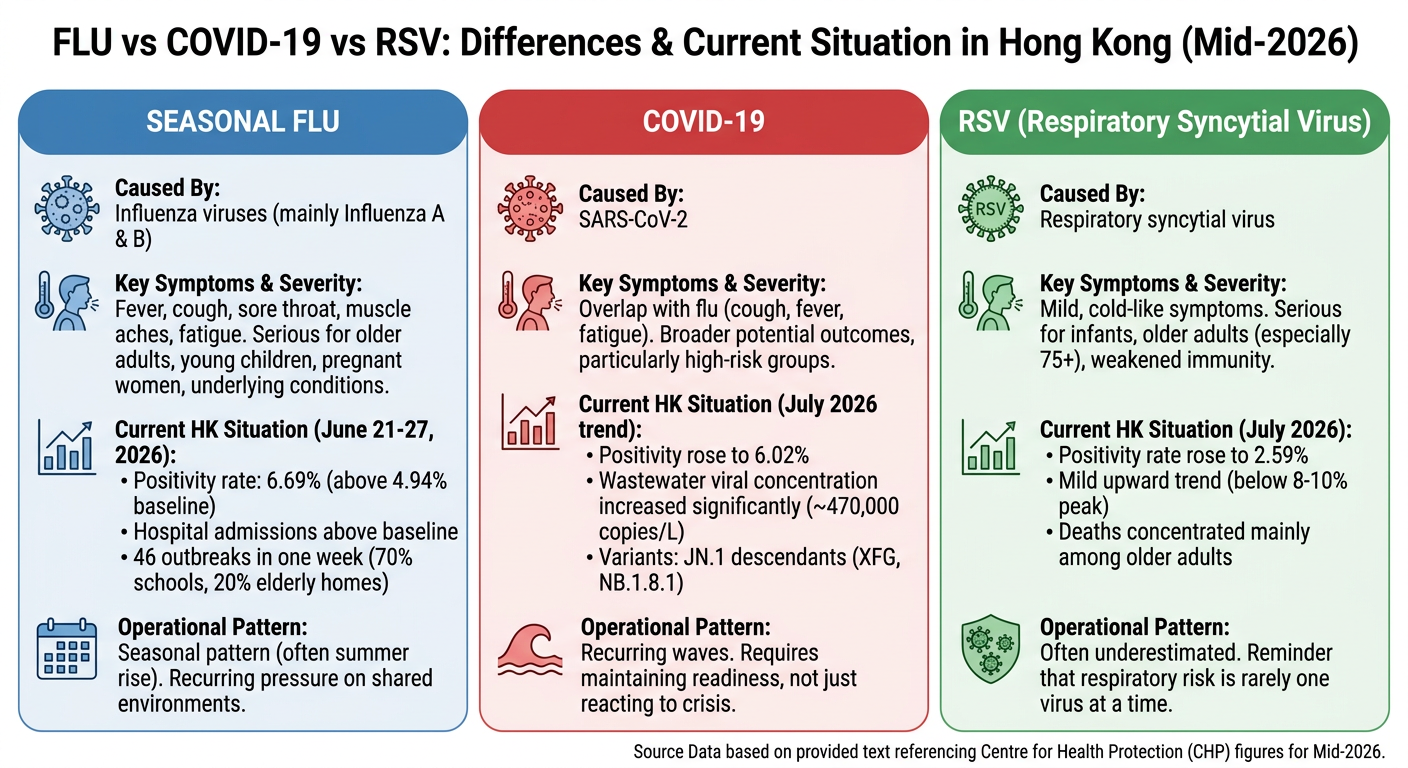
Differences of Flu vs COVID vs RSV
But for facility operators, the more important overlap is practical: all three can place strain on shared environments when hygiene standards are inconsistent or difficult to sustain.
This applies especially in:
schools and kindergartens,
elderly homes,
clinics and healthcare waiting areas,
offices,
hotels,
retail and commercial properties,
community facilities.
In these settings, risk is rarely defined by one virus alone. It is shaped by density, contact frequency, vulnerable occupants, and whether daily hygiene practices are robust enough to keep pace with changing conditions.
Why environmental hygiene still matters
Vaccination, hand hygiene, respiratory etiquette, and staying home when unwell remain essential public health measures. But environmental hygiene also has an important role, particularly when multiple respiratory viruses are circulating at the same time.
This goes beyond appearance. Effective environmental hygiene is about how shared spaces are maintained in routine use: high-touch surfaces, washrooms, reception areas, common rooms, desks, rails, lift buttons, shared devices, and other frequently contacted points. In busy environments, these spaces are part of operational continuity as much as infection prevention.
For many organisations, the relevant question is not whether cleaning takes place. It is whether hygiene measures are:
consistent,
practical to sustain,
appropriate to the setting,
supported by the right workflows and tools.
What facilities should review now
Periods of rising respiratory activity are a useful time to review the fundamentals.
1. High-touch points
Review the surfaces people contact repeatedly throughout the day, including door handles, handrails, lift buttons, desks, counters, washroom fixtures, touchscreens, pantry surfaces, and waiting-area furniture.
2. Cleaning and disinfection frequency
Routine schedules may need adjustment in high-traffic or higher-risk settings, especially when community virus activity is rising.
3. Workflow consistency
Protocols are only effective if they are carried out consistently. Staff training, clear procedures, and practical execution all matter.
4. Product suitability
Different facilities have different operating realities. A school, clinic, elderly home, office, or hotel may all require effective disinfection, but not every approach is equally suitable for every site.
A practical approach to more resilient hygiene routines
For many organizations, the challenge is not understanding why hygiene matters. It is maintaining standards reliably across real-world conditions, staffing pressures, and busy shared spaces. That is where structured hygiene solutions can support day-to-day consistency.
In larger or more complex environments, Whiz Gambit can support standardized cleaning and disinfection workflows, helping teams maintain more consistent coverage across shared spaces.
Complementing the routine hygiene protocols, a disinfectant such as Nanocyn may be considered where organizations require a safe and effective solution for repeated use.
The goal is not to make hygiene more visible. It is to make it more dependable.
The broader takeaway
Hong Kong’s current respiratory trend is straightforward: flu is above baseline, COVID-19 is rising, and RSV is also moving upward. For organisations responsible for shared environments, the implication is equally clear. Environmental hygiene should not be treated as cosmetic or secondary. It is part of how safer, better-managed facilities are maintained.
In dense, high-contact urban settings, everyday spaces matter. And when multiple respiratory viruses are circulating at once, the quality and consistency of hygiene routines become more than operational detail. They become part of preparedness.
公共衞生的警號,不一定總是大鑼大鼓。更多時候,它是悄然累積的——課室裏請假的學生多了幾個,安老院舍出現呼吸道症狀的院友多了一兩個,前線團隊因人手緊張而運作吃力。當趨勢變得清晰可見,往往已對日常運作構成實質影響。
這正是本港目前面對的寫照。根據衞生防護中心截至二〇二六年七月二日的監測數據,季節性流感活躍度已超越基線水平,新冠病毒(COVID-19)活動持續上升,而呼吸道合胞病毒(RSV)亦呈溫和升勢。對於學校、安老院、診所、辦公室、酒店及各類共用設施而言,這不單是公共衞生的最新情報,更是一記提醒:環境衞生,依然是風險管理中不可忽視的實務環節。
呼吸道病毒經常被放在一起討論,但它們之間的分別,絕對不容忽視。季節性流感、COVID-19 與 RSV 由不同病毒引起,威脅的高危族群各有側重,流行規律亦不盡相同。然而,它們卻為營運者帶來類似的難題:如何在人群聚集、頻繁走動、每日觸碰大量共用表面的環境中,維持更安全、更具應變能力的空間。
甚麼是季節性流感?
季節性流感是由甲型及乙型流感病毒引致的傳染性呼吸道疾病,常見病徵包括發燒、咳嗽、喉嚨痛、肌肉痠痛、頭痛及疲倦。對大部分人而言,流感雖然辛苦,但通常會自行痊癒;不過對長者、幼兒、孕婦及長期病患者來說,卻可能引發嚴重併發症。
在本港,流感一般呈季節性流行,夏季往往較為活躍。衞生防護中心最新數據顯示,2026年6月21至27日這一周,呼吸道樣本對流感病毒呈陽性的比率達 6.69%,高於 4.94% 的基線水平;流感相關入院率亦同樣超越基線。
爆發數字尤其值得關注。防護中心在同一周內錄得 46 宗學校及院舍的類流感疾病爆發,而近期每周平均為 24 宗;其中約七成爆發源自學校,約兩成來自安老院舍。這些數字清楚說明,流感絕非僅限於家庭內的疾病,而是隨時可能在共享環境中演化為營運管理上的難題。
甚麼是 COVID-19?
COVID-19 由新冠病毒 SARS-CoV-2 引起。雖然緊急狀態已成過去,但病毒仍以波浪式持續傳播。其病徵與流感重疊,包括發燒、咳嗽、疲倦、喉嚨痛及鼻塞,然而 COVID-19 對高危族群的潛在影響範圍更廣,後果亦更難預測。
本港近期的趨勢相當明確。呼吸道樣本的新冠陽性比率由2026年五月初的 0.45% 升至 6.02%,污水監測則顯示病毒濃度由每公升約 36,000 拷貝數增至約 470,000 拷貝數;主要流行變異株為 JN.1 的子代,包括 XFG 及 NB.1.8.1。
從管理角度而言,重點不在於記住變異株的名稱,而在於掌握模式。新冠病毒依然有能力反覆衝擊職場、校園、護理機構及公共場所。因此,衞生規劃的焦點,與其說是緊急應變,不如說是維持恆常戒備。
甚麼是 RSV?
RSV(呼吸道合胞病毒)常被形容為一種常見的呼吸道病毒,只會引起類似傷風的輕微不適。這個說法大致正確,卻未盡全面。
事實上,RSV 對嬰幼兒、長者,以及免疫力較弱或患有慢性疾病的人士,可以造成相當嚴重的影響。在本港,衞生防護中心指出,RSV 相關死亡個案主要集中在長者,而 75 歲或以上長者的住院率亦明顯較高。
現時監測顯示,RSV 活躍度正在上升,但仍低於歷史高位。實驗室陽性比率升至 2.59%,而過往高峰期曾達 8% 至 10%。即使處於較低水平,RSV 在高風險族群的設施中依然不容忽視,尤其當院友、病人或訪客本身已有較高的健康風險時。
RSV 之所以經常被低估,是因為它在公眾認知上不及流感鮮明,也缺乏新冠曾經獲得的政策聚焦。但從實際角度來看,它再次提醒我們:在共用環境中,呼吸道風險從來很少由單一病毒獨挑大樑。
流感、COVID-19 與 RSV:主要分別何在?
流感、COVID-19 與 RSV 三者不能混為一談。它們在病毒特性、流行季節、影響族群及公眾認知上各有不同,但對設施營運者而言,更重要的共通點在於實際操作層面——當衞生標準參差或難以恆常維持時,這三種病毒都可能對共用環境構成壓力。
這個問題尤其適用於以下場所:
學校及幼兒園
安老院舍
診所及醫療機構候診區
辦公室
酒店
零售及商業物業
社區設施
在這些環境中,風險從來不是由單一病毒定義,而是由人流密度、接觸頻率、高危使用者,以及日常衞生措施是否足以應付不斷變化的情況這四大因素共同塑造。
環境衞生為何仍然關鍵
疫苗接種、手部衞生、佩戴口罩,以及身體不適時留在家中,依然是公共衞生的基石。但環境衞生同樣扮演着不可或缺的角色,特別是在多種呼吸道病毒同時活躍的時期。
這不單關乎「看似乾淨」。有效的環境衞生,是指共用空間在日常使用中如何被妥善維護——高接觸表面、洗手間、接待處、公共休息室、辦公桌、扶手、電梯按鈕、共用設備,以及其他經常被觸碰的地方。在繁忙的設施內,這些空間既是營運順暢的一部分,也是感染防線的重要一環。
對許多機構而言,核心問題不在於「有沒有做清潔」,而是衞生措施是否:
貫徹一致
實際可行且可持續
切合場地特性
配有合適的工作流程及工具
設施現在應檢視的四大重點
呼吸道疾病活躍期,正是檢視基本功的好時機。
1. 高接觸點
重新檢視人們一天中反覆觸碰的表面,包括門柄、扶手、電梯按鈕、桌面、櫃枱、洗手間設備、觸控屏幕、茶水間枱面,以及候診區的傢俬。
2. 清潔與消毒頻率
例行清潔時間表應按人流及風險級別靈活調整,尤其當社區病毒活躍度上升時。
3. 作業流程的一致性
再完備的程序,若未能切實執行亦屬徒然。員工培訓、清晰指引,以及切實可行的操作方式,同樣重要。
4. 產品適用性
不同設施各有其營運實況。學校、診所、安老院、辦公室或酒店,同樣需要有效消毒,但並非每種方法都適用於所有場景。
建立更具韌性的衞生常規:務實之道
對許多機構而言,挑戰早已不在於「為何要注重衞生」,而是在實際營運壓力、人手調配及繁忙共用空間之中,如何持續維持一致標準。這時候,一套結構清晰的衞生解決方案,有助支援日常執行的穩定性。
在較大型或較複雜的環境中,Whiz Gambit 可協助標準化清潔與消毒流程,幫助團隊在共用空間達致更均勻的覆蓋。
而在常規衞生程序以外,若機構需要一種安全且適合重複使用的消毒劑,Nanocyn 等產品亦可納入考慮。
目標並非讓衞生變得更「顯眼」,而是讓它變得更「可靠」。
更大層面的啟示
香港當前呼吸道疾病的趨勢相當明確:流感高於基線、新冠病毒正在上升、RSV同步攀升。對於負責管理共用空間的機構而言,啟示同樣清晰:環境衞生不應被視為表面工夫或次要環節,而是維持更安全、更完善管理的基礎。
在這個人口密集、接觸頻繁的都市,日常空間絕非小事。當多種呼吸道病毒同時活躍時,衞生措施的品質與一致性,便不再只是營運細節——它們已成為機構應變能力的核心一環。